Is your catalog already old before going to print?
Graphics have nothing to do with it. It's a problem of data, flows, and synchronization.
Every company with many products discovers this sooner or later. (Often just before a trade fair).

The product is not the problem. It's how you tell its story.
The price list is already old when it comes out
Every salesperson has their own version
The website says one thing, the PDF another
Updating a price means opening five files
Products don't lose to better products. They lose to products that speak better.
What a catalog really is.
A catalog is not a list of products. It's the tool the salesperson opens in front of the client. It's what stays on the desk after the appointment.
If it's not clear, consistent, and easy to consult, it doesn't help sell. This is why an effective catalog must be:
Easy to consult
The needed information is found immediately. No incomprehensible indexes or constant cross-references between different pages.
Consistent with the brand
Every page breathes the company's identity. It doesn't look like an Excel sheet printed in color.
Designed to sell
The variants are clear, the product pluses evident, the technical information complete and legible.
The Lithos method
01 We bring order
Before paginating, we eliminate every duplication and inconsistency. The result is a solid database from which the catalog is born without errors.
A wrong data entry in the system becomes an error on a thousand pages. A correct data entry becomes a working catalog.
02 We automate
Static catalogs are the past; ours are born from a structured database. If a piece of information changes, only what is needed is updated.
From the printed catalog to the technical sheet, from the foreign price list to the website. The communication remains consistent everywhere.
03 We synchronize
Prices and codes remain consistent across foreign versions and updates. You update the data at the source and the system incorporates every change.
This is where the catalog stops being an annual project and becomes a continuous system.
What really changes for you.
Multilingual catalogs and price lists are connected to your real data. Updated, consistent, ready when needed, not six months later.
Concretely this means:
The catalog comes out when the products come out
No fear of pricing errors
Multilingual versions without multiplying the work
Sales network that trusts the tools
Drastic reduction in update times
The starting point for everything: the database
EasyCatalog can work with any structured source:
PIM
ERP
Database
Excel
It doesn't matter which system you use today. The important thing is that the data is in order. From there the catalog can truly work.
The technology that makes all this possible.
EasyCatalog
The end of copy-pasting

EasyCatalog connects product data directly to the layout in Adobe InDesign.
But the connection is just the end of the process.
Before:
- •the graphic template is designed
- •pagination rules are defined
- •the document is structured
From that moment the layout is generated automatically from the database. The catalog stops being a static file.
It becomes an automated editorial system.
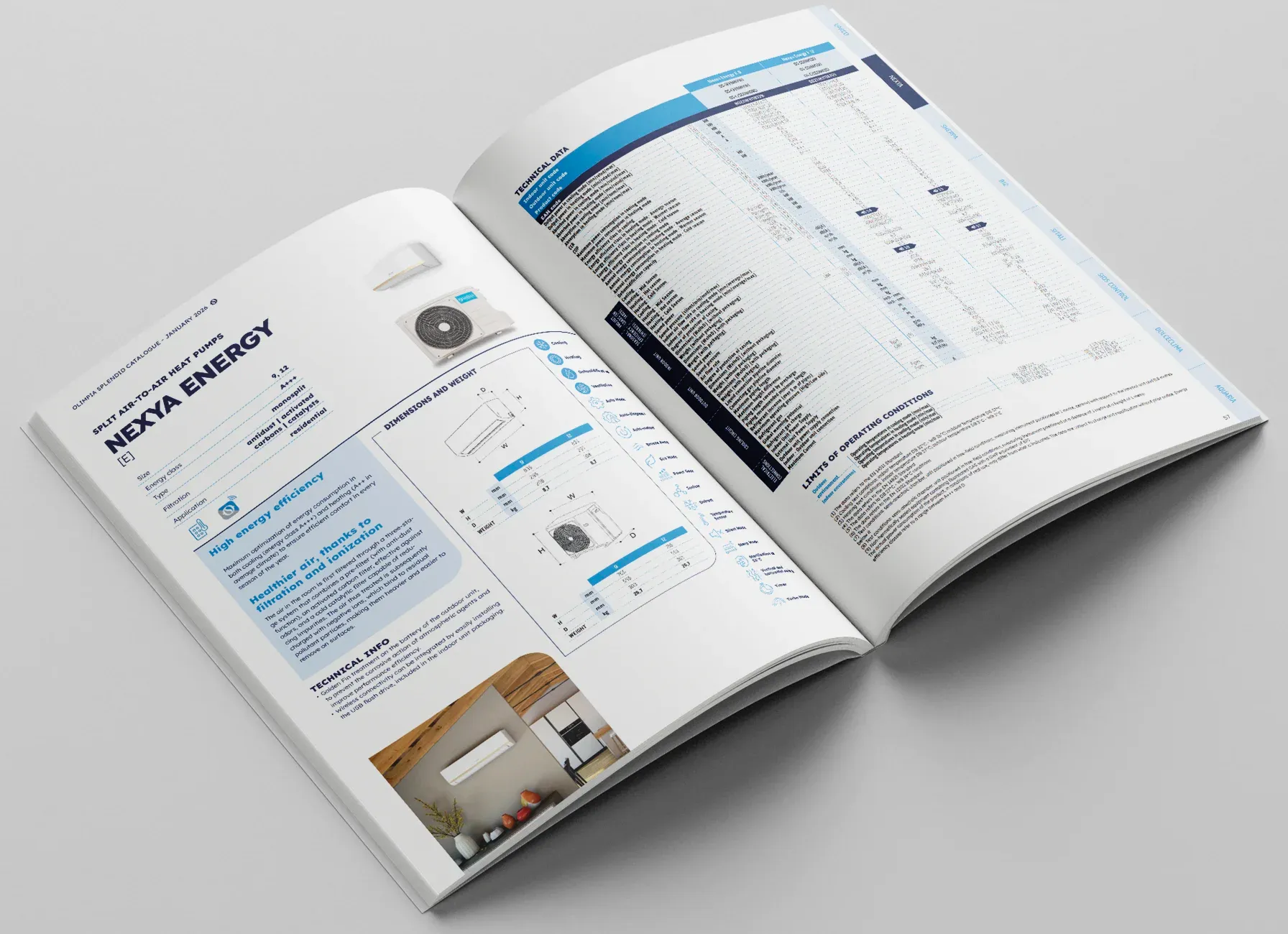
Olimpia Splendid. From 6 problems to 1 flow.
We transformed the manual management of every single language into a single automated flow, where every change is instantly replicated worldwide.

We are not a creative agency that also does digital. We are not a software house that also does graphics.
We are what happens when marketing meets the database.
Because we realized one thing: products sell well only if their data is in order.
How is your catalog today?